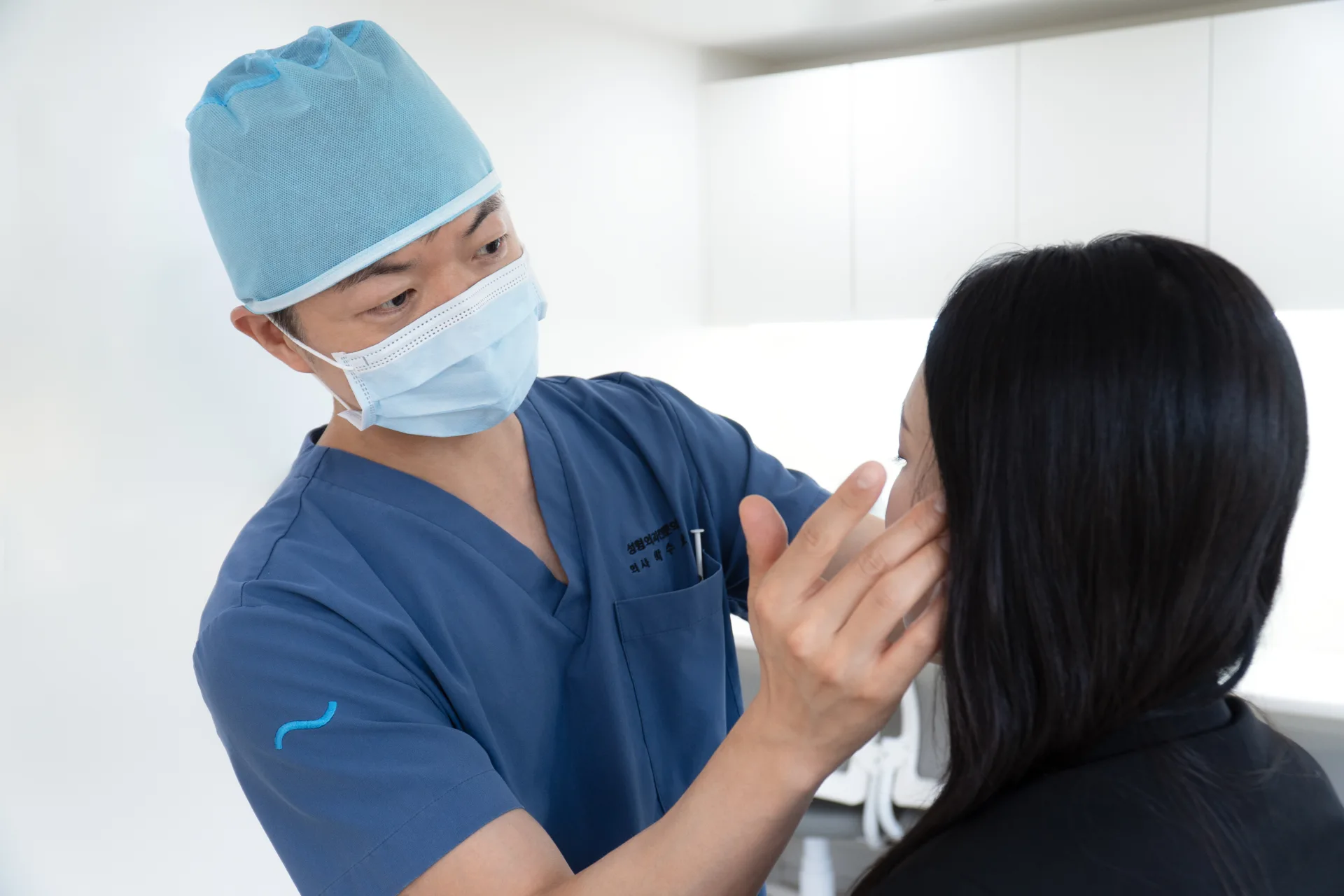
We first distinguish whether the concern is forehead height or the width at the M-shape and sides. The methods needed differ when you need to adjust height and when you need to fill the sides with hair. The reason we address forehead reduction and hair transplantation together is not to recommend both surgeries, but to divide up the roles and sequence that are necessary.
Scars are not decided only by how finely the final suturing is done. We diagnose scalp elasticity and thickness, choose the incision line while observing baby hairs and hair direction, and plan scalp movement, fixation, and layered closure. The effort to reduce tension on the skin begins at diagnosis.
After surgery you may experience numbness or tingling, worry about a red scar and associated hair shedding, or feel the unfamiliar presence of fixation devices. I believe knowing those possibilities and the individual variation in recovery before starting makes the process a more reassuring clinical experience.
The full story of our care
Things we want to share fully in the clinic
Jump to topics you are curious about, or read slowly from the beginning. You can continue reading the body here, preserving the manuscript's explanations and tone.
01
Forehead Reduction / 01
Forehead Reduction and Hair Transplant
Editorial summary: A forehead that needs to be reduced in height is different from a forehead where the M-shape or the temples need filling. We distinguish the roles of the two procedures by examining scalp elasticity, density, and how the parting looks. Brand: BANAL.
There is a more suitable method.
You do not need to give up either forehead reduction or hair transplantation. There is a more suitable method depending on the height and width of the forehead. It can be compared to glue and tape. The action of attaching is the same, but sometimes glue is better, and sometimes only tape can stick. The required method differs according to the situation.
If height is the main concern, consider forehead reduction first.
For women, the parting line is located in a place that is conspicuous when viewed from the front. At the parting, hairs split and do not overlap, so even with the same hair density the scalp tends to show through. If you lower the hairline a lot with hair transplantation, the density at the parting area can appear reduced and the scalp may be visible. Even with several touch-ups, it can still appear sparse.
In such cases, it is better to reduce the height first with forehead reduction.
There are many cases where we do not recommend forehead reduction.
If the concern is not the forehead height but a deep M-shape or wide lateral sides, hair transplantation is preferable. We do not recommend forehead reduction if the scalp has insufficient elasticity, the scalp is too thin, or the density at the parting area is low.
Bleeding, infection, widened scar, sensory reduction, asymmetry, concomitant hair loss, less reduction than expected, or re-elevation may occur. Whether surgery is possible and the extent of reduction are determined after examination.
Editorial summary: Scarring is not just a matter of how you suture. From scalp assessment to the incision line, relaxation of the galea, fixation, and layered suturing — we explain step by step the processes we inspect to reduce the tension placed on the skin. Brand: BANAL.
To reduce scars you must reduce tension.
The main reason the scar line widens after forehead reduction is high tension on the incision site. In other words, the greater the force pulling the scalp back, the higher the likelihood the scar will widen. There are many things to pay attention to 'from diagnosis to suturing' to reduce tension.
Diagnosis
You must accurately assess the characteristics of the scalp. If you fail to properly evaluate scalp elasticity, the result may differ from expectations. You may not be able to reduce the forehead as much as anticipated, and if you pull too aggressively the scar can widen or concomitant frontal hair loss can occur. Experience that allows accurate assessment of scalp characteristics is the first step toward a successful forehead reduction.
Design
You must design with the final hairline in mind. Consider whether hair transplantation will be needed after forehead reduction, how much of the baby hairs to preserve, how to hide scars among existing hairs, and the hair direction and thickness when designing the incision line.
Incision
Scars remain. What matters is how well they are concealed. With proper surgery, the scar remains as a thin line and is not highly noticeable, but using existing hair and baby hairs can conceal it even better. Selecting the incision location that considers existing hair and baby hairs is important.
Galea incision
Galea incision is the core of forehead reduction. It involves making incisions at regular intervals in the firm galea to allow the scalp to stretch sufficiently. Compared to simple forehead reduction without galea incision, this allows a much greater lowering of forehead height. However, galea incision is difficult to perform properly because there are many hair follicles and blood vessels just above the galea.
You must be able to perform galea incision to sufficient depth to achieve the desired amount of forehead reduction.
Fixation
There are reasons and limits to choosing fixation devices. The pulled scalp must be firmly fixed to the bone so it does not return. Devices called Endotain can be used, or fixation can be done with sutures. I prefer the Endotain method because it can suspend the scalp with maximal pull and I think its fixation strength is superior.
Using a mini Endotain usually prevents palpability from the outside.
Suturing
Skin suturing is merely supportive; it connects all the layers of the incised scalp. After subcutaneous suturing is finished, the skin surfaces of the incision often adhere before skin suturing is even done. The goal is to reduce the tension on the skin. Now we simply smooth and align the skin edges.
Both superficial and deep scars must be minimized.
If you eliminate the tension on the skin, most scars remain as a thin linear mark. While the visible scar is important, the scar beneath the skin must also be minimized. That makes subsequent hair transplantation easier. The size and amount of scar tissue affect hair transplant graft survival rates.
Bleeding, infection, widened scar, sensory reduction, asymmetry, concomitant hair loss, less reduction than expected, or re-elevation may occur. Whether surgery is possible and the extent of reduction are determined after examination.
Editorial summary: If you had surgery but it did not reduce enough, or the hairline rose again over time, revision surgery must consider the remaining scalp laxity, existing scars, movement potential, and fixation together. Brand: BANAL.
It should have been finished in one operation.
During revision consultations, we often see patients who had forehead reduction but did not achieve as much reduction as expected, or whose hairline that had initially lowered has risen again. When we inspect the previous surgical site during revision, sometimes the reason becomes apparent.
Reasons for insufficient lowering: galea incision
To lower the hairline significantly in forehead reduction, simply pulling the skin and scalp has limits. The process of appropriately incising and relaxing the galea so the scalp can move forward sufficiently is important. During revision surgery we sometimes find that this process was not performed adequately. Even though there was room to move the scalp further, it was closed without sufficient advancement.
The patient has gone through the burden of surgery once, yet did not fully receive the expected result.
Reasons for re-elevation: fixation
Fixation that keeps the lowered scalp in place is as important as adequately lowering it. Some patients report that the hairline was clearly lowered immediately after surgery but rose again over time. In some cases the line rose because the scar widened. When we inspect during revision, we sometimes find inadequate fixation, and occasionally we cannot find traces that fixation was performed in the previous surgery.
Lowering the hairline to the desired position is not the entire operation. Lowering it and keeping it there—both are important in forehead reduction. We consider both to be essential.
I don't want forehead reduction again.
Some patients develop distrust of forehead reduction from one experience, and even when their facial proportions or current condition suggest forehead reduction would be appropriate, they refuse further surgery and request hair transplantation only. We fully understand that sentiment. Therefore, we do not view revision surgery as simply lowering the forehead a few more centimeters.
This time the same problem should not recur. We check the remaining scalp laxity, dissect and relax the galea sufficiently as needed, and fix the lowered scalp securely so it does not re-elevate. Because we are operating on tissue that has already been operated on, revision can be more challenging than the first surgery. Nevertheless, forehead reduction revision is one of the procedures we are confident performing.
Lower it enough, maintain that position well, and consider the remaining scar when re-operating. If you were disappointed with your first forehead reduction, I hope the second surgery makes you feel, 'So this is what forehead reduction was supposed to be.'
Bleeding, infection, widened scar, sensory reduction, asymmetry, concomitant hair loss, less reduction than expected, or re-elevation may occur. Whether surgery is possible and the extent of reduction are determined after examination.
Editorial summary: If you only reduced the frontal height and the sides still look empty, consider forehead reduction together with hair transplantation; we explain why we separate the areas to do now from the areas to wait for during recovery. Brand: BANAL.
The day we reduce the forehead, we address the profile too
When consulting about forehead reduction, some patients worry about their profile as much as forehead height. Even if the forehead has been lowered enough, hollow temples can still make the face look wide, and short sideburns can leave a strangely empty appearance when the hair is tied back. If conditions permit, lateral hair transplantation can be performed simultaneously with forehead reduction.
Wait a bit for the M-shaped areas
That does not mean we do everything at once. The M-shaped hairline often overlaps with the forehead reduction incision line and the areas that would need grafting. I think it’s important to separate what’s better to do now from what’s better to do later, rather than doing every possible procedure at once. Therefore, if grafting is needed for the M-shaped areas, I recommend waiting until the forehead reduction has settled well before performing the transplant.
Conversely, if you do not need a separate transplant for the M-shaped areas, we can transplant to the temples and sideburns at the same time.
The forehead isn't only what faces forward
When we look in the mirror we do not only see the frontal forehead. We sometimes tie our hair back, turn our head to view our profile, or examine our face in photographs. So I do not think forehead reduction is simply a matter of moving the hairline downward. The frontal forehead is addressed with forehead reduction, while the M-shaped hairline, lateral areas, temples, and sideburns are treated with hair transplantation.
If doing both at once is better, we do them simultaneously; if it’s better to wait for some areas, we wait.
Bleeding, infection, widened scarring, sensory loss, asymmetry, accompanying loss of surrounding hair, less reduction than expected or re-elevation of the hairline may occur. Whether surgery is possible and the extent of reduction will be determined after examination.
Editorial summary: Sensory changes, red scars, the foreign-body feeling of fixation devices, and concurrent shedding of surrounding hairs. We want you to be fully informed not only about the improved appearance but also about the time it takes to get there before you decide. Brand: BANAL.
Sensation becomes dulled
When touching the incision area or the scalp behind it, the skin may feel unfamiliar even though it is your own. Washing your hair can feel strange, and you may experience itching or tingling. These sensations often improve over time, but they can be bothersome during recovery.
Scars do remain
Forehead reduction involves an incision along the hairline, so it is not a surgery that leaves no scar. Initially the scar can be red and noticeable. Over time it fades and is hidden by hair, but you must wait for that to happen. In most cases it is not visible at conversational distance, and if the scar continues to bother you after time has passed, it can be covered with hair transplantation.
Endotain may be palpable
Endotain is an absorbable material that gradually disappears over time, but until then it may be felt or it may seem like the endotain is moving, which can feel unfamiliar. Using a mini endotain can reduce that sensation considerably.
Accompanying loss of nearby hair can occur
During surgery, surrounding hair can experience temporary shock, causing existing, non-operated hair to fall out. There is a period when the forehead is reduced yet the hairline looks sparse, which is when patients are most worried. Most of the hair regrows, but knowing and waiting for that fact is quite different from experiencing it without knowing. I don't want to describe this as merely a surgery that reduces the forehead by a few centimeters.
I think it's important to decide with an understanding of what time and process are required. Start by knowing not only how things might improve but also the process to get there. You should feel reassured during the process as well as with the result.
Bleeding, infection, widened scarring, sensory loss, asymmetry, accompanying loss of surrounding hair, less reduction than expected or re-elevation of the hairline may occur. Whether surgery is possible and the extent of reduction will be determined after examination.
Consultation criteria summarized from the manuscript
01
Height and width are different issues
We assess density revealed by parting, the M-shape and sides, and scalp elasticity and thickness to distinguish the roles of forehead reduction and hair transplantation.
02
Plans to reduce scarring start with diagnosis
We consider not only incision location but also how to relax and fix the scalp and the tension placed on the skin. Surgery without any scar is not possible.
03
We separate what to do together and what to wait for
Temples and sideburns can be considered together depending on conditions, but M-shapes overlapping an incision line may be addressed with transplantation after recovery.
This is an edited version composed based on clinic-provided clinical manuscripts. We preserved the original explanations and tone where possible, and adjusted expressions that assert outcomes and cost policies to match public guidance. Articles whose individual authorship has not been confirmed are labeled as BANAL medical staff manuscripts. Final medical verification is pending.
A decision made after sufficient explanation
Decide with full information
Bleeding, infection, widened scarring, sensory loss, asymmetry, associated hair loss, inadequate reduction or re‑elevation may occur. Operability and reduction range are determined after examination.
Your questions, answered
Forehead Reduction · FAQ
01How many centimeters can the forehead be reduced?
We cannot promise a fixed measurement. A safe range depends on scalp elasticity and thickness, existing hairline, and surgical history.
02Will there be no scar?
Forehead reduction involves an incision and will leave a scar. We plan to minimize visibility through incision location, tension control, suturing, and aftercare.
03Is forehead reduction better for M‑shaped hairlines?
If the concern is M‑shape or lateral width rather than height, hair transplant may be more suitable. We assess the entire hairline.
04Can hair transplant be done at the same time?
We evaluate whether both are needed and the appropriate sequence. Simultaneous procedures are not suitable in all cases.
05What if scalp elasticity is insufficient?
We avoid excessive reduction and consider other methods or limited ranges. Alternatives are explained in consultation.
06Is revision after a prior forehead reduction possible?
Possibility can be assessed, but prior scars, scalp condition, and previous techniques may limit options.
07Can sensation change after surgery?
Numbness or altered sensation around the incision can occur. Recovery patterns and durations vary by individual.
08Do you recommend surgery for every high forehead?
No. We consider not only height but hair density, scalp characteristics, desired change, and risks before recommending surgery.
09What should I prepare before consultation?
Prepare details of the change you want, current medications, and past surgeries or medical history. Photos of your usual hairstyle or past photos can help.
10Do I have to decide on surgery the day of consultation?
No. Take time to understand expected changes, limitations, risks, and costs before deciding.
11Who performs the surgery?
At BANAL, the operating surgeon is responsible from design to completion. Confirm the assigned surgeon and surgical scope during consultation.
12How long does the surgery take?
Duration varies by method, scope, graft count, and past surgical history. We provide an individualized estimate after consultation.
13What about pain and anesthesia?
We explain an anesthesia plan tailored to the procedure and individual. Pain varies by person; inform us of past anesthesia experiences and drug allergies.
14Can I return to daily life immediately?
Depends on the procedure, your job, swelling and wound healing. Discuss timelines for return to work, exercise, and wearing hats during consultation.
15When can I shampoo?
Care instructions vary by surgical site and method. Follow the timing and cleansing methods provided by the clinic.
16When are results evaluated?
Hair growth and wound healing take time. Do not judge by immediate post‑operative appearance; follow the clinician's follow‑up schedule for assessment.
17Should I stop my medications before surgery?
Do not stop medications on your own. Tell medical staff about prescriptions, supplements, and allergies so they can advise on adjustments.
18How do I check costs?
Costs vary by planned method, scope, and graft count. Call the main number or consult in person to confirm itemized costs and included care.
19Can I consult if I live abroad?
Yes. Before visiting, inform the clinic of desired consultation language and possible travel dates. Confirm interpreter availability and post‑operative care plans in advance.
20What if I have uncomfortable symptoms after surgery?
Contact the clinic using the details provided. For sudden severe pain, ongoing bleeding, breathing difficulty, or other urgent symptoms, seek emergency care immediately.
This is an edited version composed based on the clinic-provided manuscript. Quotations in the manuscript that introduce medical staff use the provided wording. Medical staff and translations require verification before publication.