
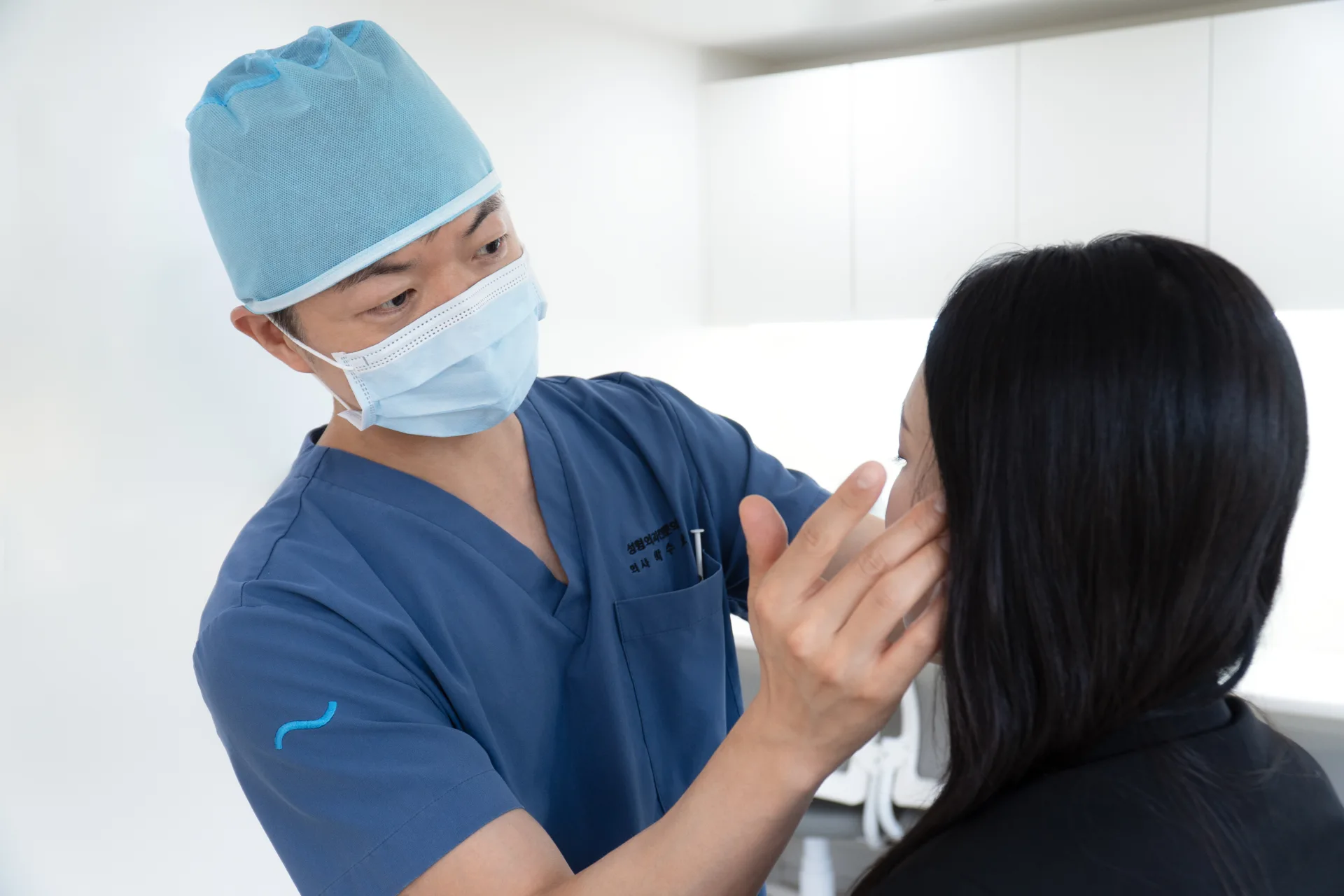
Quoted source text: "Visible scars on the surface are important, but scarring beneath the skin must also be minimized."
To reduce scars you must reduce tension.
The main reason the scar line widens after forehead reduction is high tension on the incision site. In other words, the greater the force pulling the scalp back, the higher the likelihood the scar will widen. There are many things to pay attention to 'from diagnosis to suturing' to reduce tension.
Diagnosis
You must accurately assess the characteristics of the scalp. If you fail to properly evaluate scalp elasticity, the result may differ from expectations. You may not be able to reduce the forehead as much as anticipated, and if you pull too aggressively the scar can widen or concomitant frontal hair loss can occur. Experience that allows accurate assessment of scalp characteristics is the first step toward a successful forehead reduction.
Design
You must design with the final hairline in mind. Consider whether hair transplantation will be needed after forehead reduction, how much of the baby hairs to preserve, how to hide scars among existing hairs, and the hair direction and thickness when designing the incision line.
Incision
Scars remain. What matters is how well they are concealed. With proper surgery, the scar remains as a thin line and is not highly noticeable, but using existing hair and baby hairs can conceal it even better. Selecting the incision location that considers existing hair and baby hairs is important.
Galea incision
Galea incision is the core of forehead reduction. It involves making incisions at regular intervals in the firm galea to allow the scalp to stretch sufficiently. Compared to simple forehead reduction without galea incision, this allows a much greater lowering of forehead height. However, galea incision is difficult to perform properly because there are many hair follicles and blood vessels just above the galea.
You must be able to perform galea incision to sufficient depth to achieve the desired amount of forehead reduction.
Fixation
There are reasons and limits to choosing fixation devices. The pulled scalp must be firmly fixed to the bone so it does not return. Devices called Endotain can be used, or fixation can be done with sutures. I prefer the Endotain method because it can suspend the scalp with maximal pull and I think its fixation strength is superior.
Using a mini Endotain usually prevents palpability from the outside.
Suturing
Skin suturing is merely supportive; it connects all the layers of the incised scalp. After subcutaneous suturing is finished, the skin surfaces of the incision often adhere before skin suturing is even done. The goal is to reduce the tension on the skin. Now we simply smooth and align the skin edges.
Both superficial and deep scars must be minimized.
If you eliminate the tension on the skin, most scars remain as a thin linear mark. While the visible scar is important, the scar beneath the skin must also be minimized. That makes subsequent hair transplantation easier. The size and amount of scar tissue affect hair transplant graft survival rates.
Bleeding, infection, widened scar, sensory reduction, asymmetry, concomitant hair loss, less reduction than expected, or re-elevation may occur. Whether surgery is possible and the extent of reduction are determined after examination.