
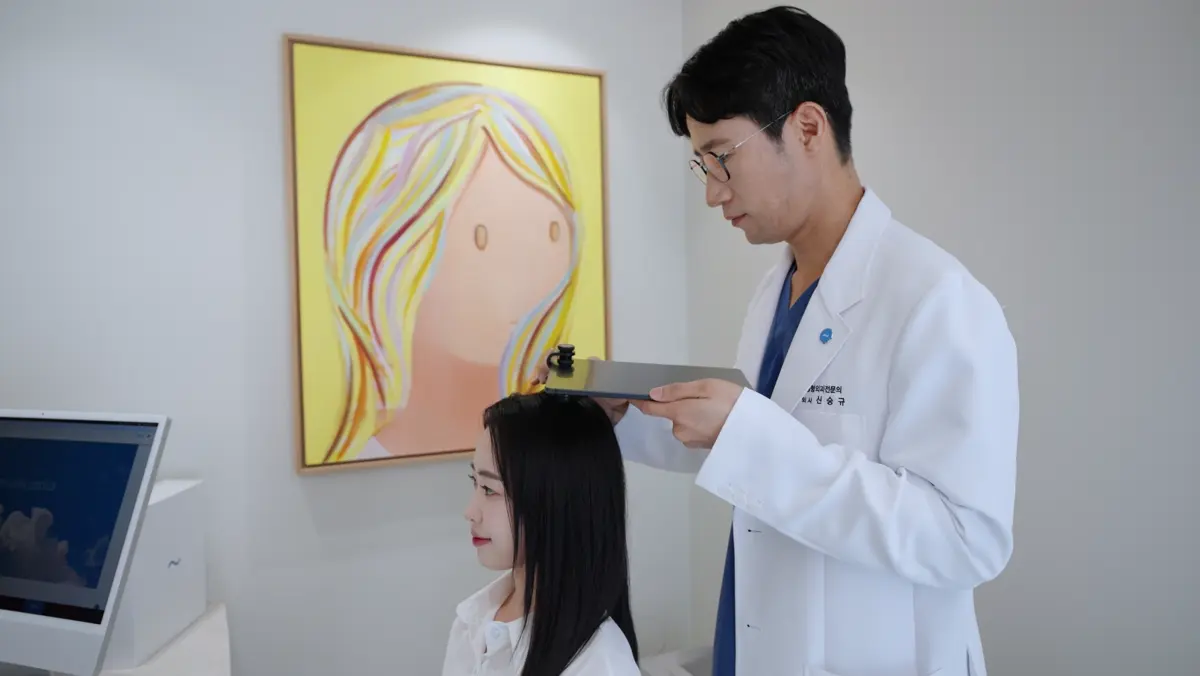
Rather than drawing a line well, make the line invisible.
The Hairline Is Not a Line
"The hairline is not a line." This was said by a director I respect. When I first heard it I thought it was a good phrase, but the more hair transplants I perform the more I believe this is truly correct. When designing a hairline we first draw a line. But what remains on the forehead after surgery is not the line we drew.
The Aesthetics of Irregularity
When you examine a natural hairline up close, the boundary between skin and hair is not sharply divided as if cut with a knife. In the front there are thin, delicate hairs scattered sparsely, and as you move backward the hairs gradually become thicker and denser. In some spots one or two hairs come forward, and in other spots the line recedes slightly. Those small irregularities together create the hairline we perceive as natural.
Though it is called a hairline, it is a paradox of not being a line.
Thousands of Choices
Hairline design does not end with the line drawn before surgery. Each time we plant a graft, a new small choice begins. Should this hair be placed a little more forward, or slightly set back? Should it lie a bit flatter than the neighboring hair, or have its direction subtly altered? Should we use a thin hair here or a slightly thicker one? Should we add one more unit of density, or would leaving a small gap actually look more natural?
Those kinds of choices are repeated thousands of times. And those small choices together form a single hairline.
A Good Hairline Makes the Line Invisible
In hairline surgery perhaps the best outcome is that no one realizes surgery was performed. It's difficult to tell where the implanted hair begins; it looks as if it were always that person's hair. Rather than drawing the line well, making that line invisible—that is, I think, the most difficult part of hairline transplantation.
Of course there are limits. But with that mindset we do our best. The more surgeries we do, the more follow-ups we see, the more that short phrase feels significant. The hairline is not a line.
Bleeding, infection, scarring, folliculitis, and temporary accompanying shedding may occur after hair transplantation. Density and naturalness may be limited by the original hair thickness and direction and by donor resources in the occipital area.